Nucelion and Pandorum Partner on Two Experimental Eye Therapies in India
Nucelion Therapeutics and Pandorum Technologies join hands on two PRIP-backed eye therapy projects targeting corneal disease and wet AMD, with funding of up to ₹8 crore.Therapies in India
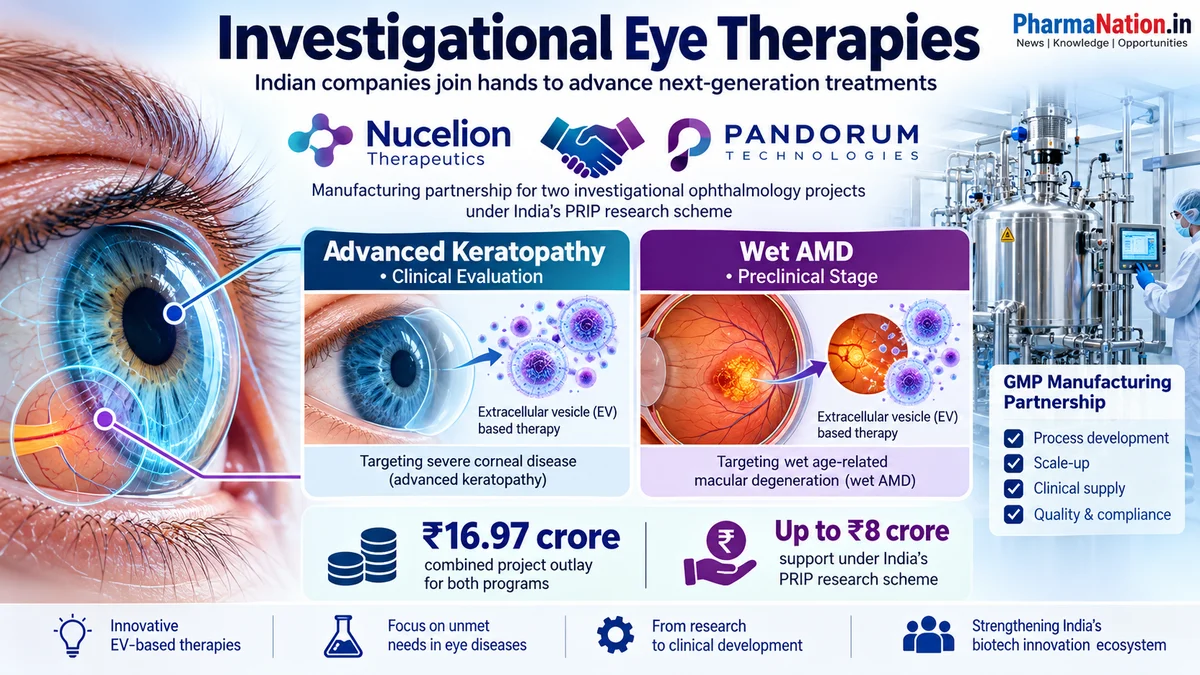
India’s pharmaceutical research sector has taken another step towards developing advanced regenerative medicines. Hyderabad-based Nucelion Therapeutics and Bengaluru-based Pandorum Technologies have announced a manufacturing partnership to advance two investigational therapies targeting serious eye diseases.
The programmes focus on advanced keratopathy, which affects the cornea, and wet age-related macular degeneration (wet AMD), a disease affecting the retina. The two projects have a combined planned outlay of ₹16.97 crore, including up to ₹8 crore in funding through the government’s Promotion of Research and Innovation in Pharma-MedTech (PRIP) scheme. The partnership was reported on 28 October 2026.
The collaboration combines Pandorum’s designer-exosome technology with Nucelion’s expertise in pharmaceutical process development and manufacturing. It highlights the growing importance of specialised manufacturing in bringing experimental biological therapies from research towards clinical evaluation.
Important: These are investigational programmes, not established treatments available for routine patient use. Their clinical benefits, safety and regulatory status must be evaluated separately as development progresses.
1. WHAT IS THE NEW PARTNERSHIP ABOUT?
Nucelion Therapeutics, a wholly owned subsidiary of Bharat Biotech, is partnering with Pandorum Technologies to support two ophthalmology research programmes.
Pandorum is developing regenerative medicines based on designer exosomes, while Nucelion will contribute process development and manufacturing support. The work is intended to help produce consistent, quality-controlled materials suitable for the respective development stages of the two programmes.
The collaboration also aims to support the production of materials under Good Manufacturing Practice (GMP) requirements for clinical studies in India and abroad, subject to the necessary regulatory approvals.
The two companies bring different capabilities to the project. Pandorum contributes its research platform and therapeutic development expertise, while Nucelion contributes specialised development and manufacturing infrastructure for advanced biological products.
Source: https://www.expresspharma.in/nucelion-pandorum-partner-on-two-prip-backed-ophthalmology-projects/
2. WHAT ARE DESIGNER EXOSOMES?
Exosomes are small, membrane-bound extracellular vesicles involved in communication between cells. They can carry biological molecules that influence how cells respond to their surroundings.
Researchers are studying these vesicles as potential tools for delivering biological signals and influencing processes involved in inflammation, tissue damage and repair.
Pandorum’s designer-exosome approach aims to tune biological activity to address processes such as inflammation, fibrosis and abnormal vascular activity while supporting tissue repair.
However, the scientific potential of this technology should not be confused with proven clinical effectiveness. Researchers must establish how consistently the product can be manufactured, how it behaves in the body, what risks it may carry and whether it provides meaningful benefits to patients.
This makes manufacturing quality a central part of development rather than simply a later production step.
3. FIRST PROGRAMME: ADVANCED KERATOPATHY
The first programme focuses on advanced keratopathy, a broad term covering serious diseases or damage affecting the cornea, the transparent front surface of the eye.
The cornea plays an essential role in focusing light. Significant corneal damage or disease can affect vision and, in severe cases, threaten sight.
The programme is directed towards clinical evaluation of an investigational therapy for severe corneal disease. The research aims to explore whether regenerative approaches can help address tissue damage and support repair.
For patients with serious corneal conditions, new therapeutic approaches could eventually be valuable if they demonstrate safety and effectiveness. Nevertheless, the partnership announcement does not establish that the investigational therapy has been proven to restore vision or prevent blindness.
Any potential benefit will need to be demonstrated through appropriately designed studies and the required regulatory review.
4. SECOND PROGRAMME: WET AGE-RELATED MACULAR DEGENERATION
The second programme targets wet age-related macular degeneration, commonly called wet AMD.
AMD affects the macula, the central part of the retina responsible for detailed central vision. In the wet form, abnormal blood vessels grow beneath or within retinal tissue and may leak fluid or blood, damaging vision.
Current management can include medicines administered into the eye that target vascular endothelial growth factor (VEGF). These treatments can help control abnormal blood vessel activity and preserve vision in many patients, although treatment requirements and outcomes vary.
Pandorum’s wet-AMD programme is at the preclinical development stage, according to the published announcement. It is focused on preparing the investigational approach for possible later clinical development.
Preclinical research generally involves laboratory studies and, where appropriate, studies in relevant experimental models before human trials can begin. Progression to clinical studies depends on the evidence generated and the applicable regulatory requirements.
The partnership therefore represents an early development effort, not a new approved alternative to existing wet-AMD treatments.
5. WHY IS MANUFACTURING SO IMPORTANT IN REGENERATIVE MEDICINE?
Advanced biological therapies can be more complex to manufacture than conventional chemical medicines. Their quality may depend on biological starting materials, production conditions, purification methods, analytical testing, storage and handling.
A product that shows promising activity in an early laboratory experiment must also be produced consistently enough for meaningful research and clinical evaluation.
Nucelion’s role includes process development and manufacturing support tailored to the requirements and stage of each programme. The goal is to establish reproducible processes and appropriate quality controls.
GMP is an important part of this work. It provides a framework for ensuring that products are manufactured and controlled consistently according to applicable quality standards.
For emerging therapies, manufacturing readiness can help researchers generate reliable study material and reduce avoidable variability between batches. It does not, by itself, establish that a medicine is safe or effective.
6. HOW DOES THE PRIP SCHEME SUPPORT THE PROJECTS?
The Promotion of Research and Innovation in Pharma-MedTech Sector scheme is a government initiative designed to strengthen pharmaceutical and medical technology research in India.
The Department of Pharmaceuticals lists a total scheme outlay of approximately ₹5,000 crore. Its objectives include supporting drug discovery, developing innovative medical technologies, promoting industry-academia collaboration and encouraging a shift towards innovation-led growth.
On 30 September 2026, the government announced that 41 projects had received around ₹1,600 crore in financial assistance under the first call. These projects were expected to attract an additional ₹3,020 crore in private investment, bringing the projected combined research investment to approximately ₹4,620 crore.
The approved portfolio included new medicines, complex generics, biosimilars and novel medical devices. The government also highlighted research areas addressing significant public-health needs.
Source: https://www.pib.gov.in/PressReleseDetailm.aspx?PRID=2317296&lang=1®=3
The two ophthalmology projects demonstrate how public research support can be combined with private-sector research and manufacturing capabilities. The announced combined project outlay is ₹16.97 crore, with up to ₹8 crore in PRIP funding.
This support can help advance research, but funding does not guarantee that a candidate therapy will succeed in clinical trials or receive marketing approval.
7. WHAT COULD THIS MEAN FOR INDIA’S PHARMA INDUSTRY?
The collaboration highlights a developing area of the pharmaceutical industry: advanced biological therapies that require specialised manufacturing, testing and regulatory expertise.
India has an established pharmaceutical manufacturing base. Building stronger capabilities in regenerative medicine and other advanced therapies could help expand the industry beyond conventional generics into more research-intensive products.
For biotechnology companies, access to experienced manufacturing partners may help address the practical challenges of scaling research programmes. For specialised manufacturers, such partnerships can create opportunities to support products at different stages of development.
For universities, research institutions and pharmaceutical professionals, the field also highlights the importance of interdisciplinary skills in biotechnology, analytical development, quality assurance, process engineering and regulatory affairs.
The longer-term impact will depend on whether the programmes generate convincing scientific evidence, progress through the required development stages and demonstrate meaningful clinical value.
8. WHAT HAPPENS NEXT?
The two programmes will progress according to their individual research findings, development milestones and regulatory requirements.
The advanced-keratopathy programme is directed towards clinical evaluation, while the wet-AMD programme remains focused on preclinical development and preparation for possible clinical translation.
Important milestones to watch include manufacturing reproducibility, analytical quality data, relevant preclinical findings, regulatory permissions and the design and results of any future clinical studies.
No routine patient availability date has been established in the partnership announcement. Patients should continue to follow advice from qualified eye specialists and should not replace prescribed treatment with an experimental therapy outside an appropriately authorised clinical study.
FREQUENTLY ASKED QUESTIONS
1. Which companies are involved?
Nucelion Therapeutics, a wholly owned subsidiary of Bharat Biotech, and Pandorum Technologies, a Bengaluru-based regenerative medicine company.
2. Which eye diseases are being studied?
The programmes target advanced keratopathy, involving serious corneal disease, and wet age-related macular degeneration, which affects the retina.
3. What are designer exosomes?
They are engineered extracellular vesicle-based approaches being investigated for their ability to deliver biological signals and influence cellular responses. Their clinical effectiveness must be established through research.
4. How much funding is involved?
The two projects have a combined planned outlay of ₹16.97 crore, including up to ₹8 crore in PRIP scheme support.
5. Are these therapies available to patients now?
The announcement describes investigational programmes at different development stages. It does not establish that either therapy is approved for routine clinical use.
CONCLUSION
The partnership between Nucelion Therapeutics and Pandorum Technologies represents a new development in India’s regenerative medicine research ecosystem. By combining designer-exosome research with specialised manufacturing support, the companies aim to advance two investigational programmes addressing serious eye diseases.
The ₹16.97-crore combined project outlay, including up to ₹8 crore in PRIP support, demonstrates the role of public funding in helping innovative pharmaceutical research move towards further development.
The next major test will be scientific and clinical evidence. Manufacturing consistency, safety, effectiveness and regulatory approval—not the announcement alone—will determine whether these experimental approaches eventually become useful treatments for patients.
SOURCES AND REFERENCES
1. Express Pharma — Nucelion and Pandorum partner on two PRIP-backed ophthalmology projects:
https://www.expresspharma.in/nucelion-pandorum-partner-on-two-prip-backed-ophthalmology-projects/
2. Department of Pharmaceuticals — PRIP scheme overview:
https://pharma-dept.gov.in/prip/
3. Press Information Bureau — PRIP innovation projects, 30 September 2026:
https://www.pib.gov.in/PressReleseDetailm.aspx?PRID=2317296&lang=1®=3
4. BioSpectrum India — Pandorum and Nucelion manufacturing partnership:
https://www.biospectrumindia.com/news/96/28742/pandorum-and-nucelion-manufacturing-partnership-to-advance-two-designer-exosome-programmes-in-ophthalmology-.html
DISCLAIMER
This article is for educational and informational purposes. The therapies described are investigational, and their safety, effectiveness and availability depend on further evidence and applicable regulatory approvals.
Esskay bhayana, being a registered pharmacist & having more than 30+ years of experience, covers news and latest innovations in the pharmaceutical industry.
More from this section
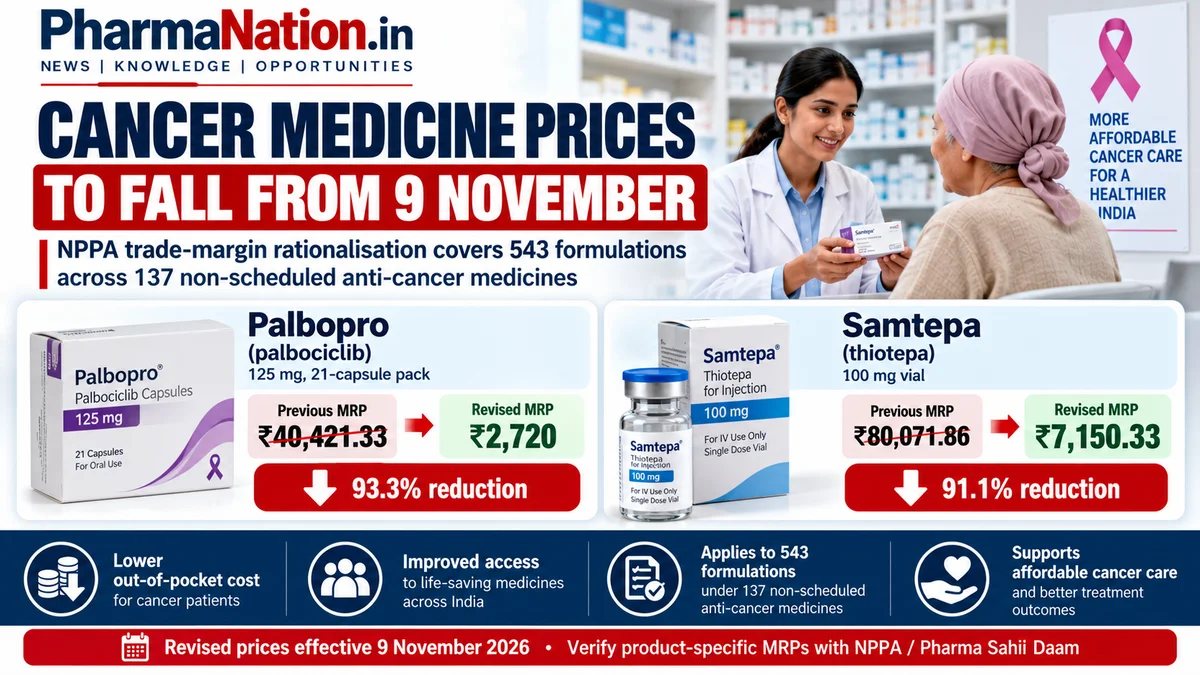
NPPA ने घटाईं 543 कैंसर दवा फॉर्मूलेशन की कीमतें, 9 नवंबर से नई दरें लागू
NPPA Cuts Prices of 543 Cancer Medicine Formulations from November 9

CDSCO Cancels FatX Solution Registration Over Misleading Claims: Key Lessons for India’s Cosmetic Industry


Reader Comments
Comments are reviewed by our desk before they appear. Sign in with your mobile number to join the discussion.