CDSCO Approves Zytorvi for Advanced Oesophageal Cancer in India
CDSCO approves Dr. Reddy’s Zytorvi (toripalimab) with chemotherapy for advanced oesophageal cancer. Explore clinical evidence, safety and industry impact.
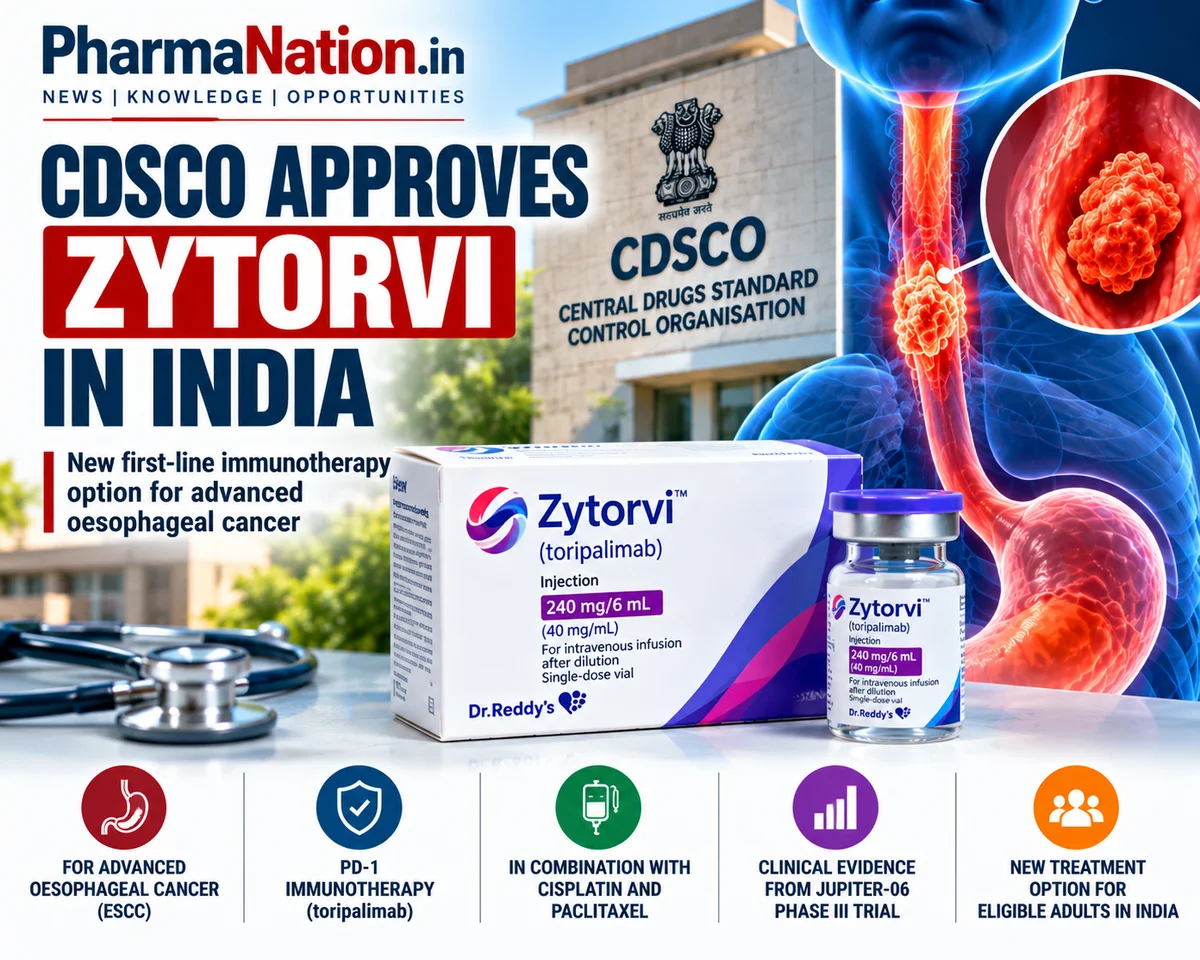
India’s oncology treatment landscape has gained another regulatory development following approval of Zytorvi (toripalimab), an immunotherapy developed by Shanghai Junshi Biosciences and commercialised in India by Dr. Reddy’s Laboratories.
On 21 October 2026, Dr. Reddy’s announced that the Central Drugs Standard Control Organisation (CDSCO), under the Drugs Controller General of India (DCGI), had approved Zytorvi in combination with cisplatin and paclitaxel for the first-line treatment of adults with unresectable advanced, recurrent or metastatic oesophageal squamous cell carcinoma (ESCC). The approval expands the medicine’s use beyond its previously approved indication in nasopharyngeal carcinoma. Source: Dr. Reddy’s regulatory announcement
The development is significant because it brings an additional immunotherapy-based treatment option into a disease setting where patients may face limited treatment choices. However, regulatory approval does not mean the treatment is appropriate for every patient, nor does it establish immediate nationwide availability or affordability.
For pharmaceutical professionals, the approval also illustrates how clinical-trial evidence, regulatory decisions, licensing agreements and commercial access intersect in the development of specialist medicines.
Key highlights
Medicine: Zytorvi (toripalimab), a monoclonal antibody targeting PD-1.
Regulatory authority: CDSCO under the DCGI.
Combination treatment: Toripalimab with cisplatin and paclitaxel.
Approved population: Adults with unresectable advanced, recurrent or metastatic ESCC.
Clinical evidence: The Phase III JUPITER-06 trial evaluated the combination in 514 patients.
Reported survival outcome: Final analysis showed median overall survival of 17.7 months with toripalimab plus chemotherapy, compared with 12.9 months with chemotherapy alone.
Important qualification: These are trial results, not a prediction of survival for an individual patient.
Sources: Dr. Reddy’s announcement and JUPITER-06 final analysis indexed by PubMed.
What is Zytorvi (toripalimab)?
Zytorvi contains toripalimab, a humanised monoclonal antibody that targets programmed cell death protein 1 (PD-1), an immune checkpoint involved in regulating immune responses.
Cancer cells can exploit immune checkpoint pathways to reduce the immune system’s ability to recognise and attack them. Toripalimab blocks the interaction between PD-1 and its ligands, PD-L1 and PD-L2, helping restore T-cell activity against cancer cells.
This treatment approach belongs to a class of medicines known as immune checkpoint inhibitors. Unlike conventional cytotoxic chemotherapy, which acts directly on rapidly dividing cells, checkpoint inhibitors work by modifying an immune-regulatory pathway.
In the newly approved Indian indication, toripalimab is used with cisplatin and paclitaxel rather than as a replacement for chemotherapy. The combination is intended for eligible adults receiving first-line systemic treatment for advanced ESCC. Source: Dr. Reddy’s announcement
Understanding oesophageal squamous cell carcinoma
The oesophagus is the muscular tube that carries food and liquids from the throat to the stomach. Oesophageal cancer develops in the tissues lining this organ and includes different histological types.
Oesophageal squamous cell carcinoma develops from squamous cells lining the oesophagus. It can become difficult to treat when it is advanced, has spread to distant sites, or has returned after previous treatment.
The term unresectable means the cancer cannot be removed through surgery under the relevant clinical circumstances. The terms recurrent and metastatic refer respectively to cancer that has returned and cancer that has spread to other parts of the body.
These distinctions matter because treatment recommendations depend on disease stage, previous treatment, the patient's general condition and other clinical factors. The new indication concerns a specific advanced-disease setting; it should not be interpreted as approval for all forms or stages of oesophageal cancer.
What did the JUPITER-06 clinical trial find?
The approval is supported by the Phase III JUPITER-06 study, a randomised, double-blind clinical trial involving 514 patients with previously untreated advanced or metastatic ESCC. Participants were assigned to receive toripalimab or placebo alongside paclitaxel and cisplatin, followed by maintenance treatment according to the assigned group.
The study evaluated progression-free survival and overall survival, among other outcomes. Its results provide evidence for adding toripalimab to chemotherapy in the population studied.
Overall survival results
The final overall-survival analysis reported the following results:
Outcome | Toripalimab plus chemotherapy | Placebo plus chemotherapy |
|---|---|---|
Median overall survival | 17.7 months | 12.9 months |
Three-year overall survival rate | 29.7% | 19.9% |
The final analysis reported a hazard ratio for death of 0.72 (95% confidence interval 0.58–0.88; P = 0.002). This corresponds to a lower relative hazard of death during the observed study period in the toripalimab group. It does not mean that every patient gains 4.8 months of life or that an individual patient's outcome can be predicted from the group median.
The trial also reported improved progression-free survival with the combination. Progression-free survival and overall survival are different endpoints: the former measures time before disease progression or death, while the latter measures time until death from any cause.
Sources: JUPITER-06 final overall-survival analysis and original Phase III trial publication.
Why the distinction between endpoints matters
News reports sometimes describe a reduction in the risk of progression or death together with median overall-survival figures. These should not be treated as the same result.
The original JUPITER-06 report found a hazard ratio of 0.58 for progression-free survival at the specified analysis, while the final overall-survival analysis reported a hazard ratio of 0.72 for death. Each estimate relates to a different endpoint and analysis period.
For healthcare professionals, pharmacy students and medical communicators, this is an important lesson in interpreting oncology data accurately. A relative reduction in a statistical hazard is not the same as an equivalent increase in life expectancy, and median survival is not a guarantee for any individual.
Does the Indian approval require PD-L1 testing for patient selection?
PD-L1 is a protein involved in immune checkpoint signalling. Its expression can be assessed in tumour tissue and is used as a biomarker in treatment decisions for certain cancers and medicines.
According to Dr. Reddy’s announcement, the Indian indication for toripalimab with chemotherapy does not require patient selection based on PD-L1 expression. This could allow otherwise eligible patients to be considered without using PD-L1 status as an eligibility filter for this indication.
That does not mean biomarker testing is unnecessary in every clinical circumstance, or that all patients will benefit equally. Treatment decisions remain the responsibility of the treating oncology team, taking account of the approved indication, clinical history and other relevant factors.
Source: Dr. Reddy’s regulatory announcement.
What are the safety considerations?
Immune checkpoint inhibitors can cause adverse reactions when immune activity affects healthy tissues as well as cancer cells. These may involve organs such as the lungs, bowel, liver, endocrine glands or skin. Cisplatin and paclitaxel also have their own toxicity profiles.
Consequently, treatment requires specialist supervision, assessment of the patient's suitability, monitoring for adverse effects and appropriate management of complications. The risks and benefits must be evaluated using the applicable Indian prescribing information and the patient's clinical circumstances.
The trial's findings should not be interpreted as evidence that the combination is risk-free. Clinical-trial populations are selected and monitored, and real-world outcomes may differ.
Patients should not seek or start oncology treatment based solely on a news report. They should discuss treatment options with a qualified oncologist.
What is the significance for India's pharmaceutical industry?
1. Expansion of oncology portfolios
The new indication broadens the use of a medicine already marketed in India for nasopharyngeal carcinoma. For pharmaceutical companies, expanding the approved uses of an existing medicine can be an important part of building a specialist oncology portfolio.
2. Licensing and commercialisation partnerships
Dr. Reddy’s entered into a licensing and commercialisation agreement with Junshi Biosciences in 2023 for toripalimab across 21 countries. The arrangement illustrates how pharmaceutical companies may combine external drug-development assets with local regulatory, distribution and commercial capabilities.
Such agreements can help companies expand their portfolios without independently discovering and developing every molecule. They also require careful management of regulatory responsibilities, supply arrangements and commercial access.
3. Clinical evidence and regulatory review
The approval demonstrates the role of Phase III clinical evidence in supporting a new indication. Regulatory authorisation evaluates the evidence for a specific use; it should not be confused with proof that a medicine is superior to every available alternative or appropriate for every patient.
4. Access and affordability remain unresolved questions
An additional authorised treatment option is only one part of improving cancer care. The actual impact depends on availability, price, insurance or reimbursement, hospital capacity, specialist expertise and patient access to treatment and monitoring.
The public approval announcement does not establish a verified nationwide launch date, retail price or reimbursement arrangement for this indication. These should be confirmed independently rather than assumed from the regulatory decision.
What should pharmacists and pharmacy students learn from this approval?
The Zytorvi development is relevant to several professional areas:
Clinical pharmacy: Understanding how immunotherapy is combined with chemotherapy and how adverse effects are monitored.
Regulatory affairs: Interpreting an approved indication and distinguishing an announced approval from broader claims about product availability.
Pharmacovigilance: Recognising the importance of identifying, documenting and reporting suspected adverse drug reactions through appropriate channels.
Medical affairs: Communicating clinical trial endpoints, relative risks and survival statistics accurately.
Pharmaceutical business: Understanding licensing agreements, indication expansion and the difference between regulatory approval and commercial access.
The broader lesson is that new-drug news should be interpreted through both the clinical evidence and the precise wording of the approved indication.
What happens next?
The immediate confirmed development is the expansion of toripalimab's approved use in India to first-line treatment of eligible adults with unresectable advanced, recurrent or metastatic ESCC in combination with cisplatin and paclitaxel.
The next practical questions concern implementation: availability, pricing, distribution, prescribing information and how the new indication is incorporated into oncology practice. These points should be verified through company disclosures, official regulatory information and appropriate healthcare channels as further information becomes available.
The CDSCO's approved-drugs database is a useful official starting point for checking listed approvals. The database currently lists toripalimab as a finished formulation with an approval date of 24 September 2026, while the company's public announcement is dated 21 October 2026. These are different dates representing the regulatory database entry and the public announcement; they should not be conflated.
Frequently asked questions
1. What is Zytorvi?
Zytorvi is the brand name for toripalimab, a monoclonal antibody that blocks the PD-1 immune checkpoint. It is used in specified cancer-treatment settings.
2. What has CDSCO approved?
The newly announced indication is toripalimab in combination with cisplatin and paclitaxel for first-line treatment of adults with unresectable advanced, recurrent or metastatic oesophageal squamous cell carcinoma.
3. What did the JUPITER-06 trial show?
The final overall-survival analysis reported median survival of 17.7 months in the toripalimab-plus-chemotherapy group versus 12.9 months in the placebo-plus-chemotherapy group. These figures describe study groups, not individual predictions.
4. Is Zytorvi a chemotherapy medicine?
No. Toripalimab is an immune checkpoint inhibitor. For this indication, it is administered in combination with the chemotherapy medicines cisplatin and paclitaxel.
5. Does every patient with oesophageal cancer qualify?
No. The indication applies to a defined group of adults with unresectable advanced, recurrent or metastatic ESCC. Eligibility and treatment selection require specialist assessment.
6. Is nationwide availability confirmed?
The approval announcement does not establish immediate availability in every hospital or pharmacy, nor does it provide a verified price or reimbursement status. These details require separate confirmation.
Conclusion
CDSCO's approval of Zytorvi (toripalimab) with cisplatin and paclitaxel for first-line treatment of eligible adults with advanced ESCC is an important development in India's oncology sector.
The Phase III JUPITER-06 trial provides evidence of improved outcomes for the combination in the population studied. At the same time, clinical results must be interpreted carefully, immune-related risks require appropriate monitoring, and access will depend on practical factors beyond regulatory approval.
For India's pharmaceutical industry, the decision highlights the continuing importance of evidence-based regulation, specialist medicines and commercial partnerships. For healthcare professionals, the central task is to understand the exact indication, communicate the evidence accurately and support safe, informed treatment decisions.
Key takeaway: The new indication expands an available treatment option for a specific advanced cancer population, but it does not guarantee benefit for every patient or establish immediate nationwide access.
Official and scientific sources
CDSCO: Approved Drugs/Vaccines/r-DNA/Blood Products database — official regulatory database.
Dr. Reddy’s Laboratories: 21 October 2026 regulatory announcement filed with the US Securities and Exchange Commission — company announcement of the new indication.
JUPITER-06 final analysis: PubMed record for final overall-survival analysis and exploratory biomarker study — clinical evidence.
Original Phase III trial: PubMed record for toripalimab plus chemotherapy in advanced ESCC — trial design and earlier efficacy analysis.
Editorial note: This article is for pharmaceutical industry and educational information, not individual medical advice. Clinical claims are based on published trial findings and the company’s regulatory announcement. The current Indian prescribing information and applicable CDSCO requirements should be consulted for clinical decisions.
Esskay bhayana, being a registered pharmacist & having more than 30+ years of experience, covers news and latest innovations in the pharmaceutical industry.
More from this section

CDSCO Cancels FatX Solution Registration Over Misleading Claims: Key Lessons for India’s Cosmetic Industry
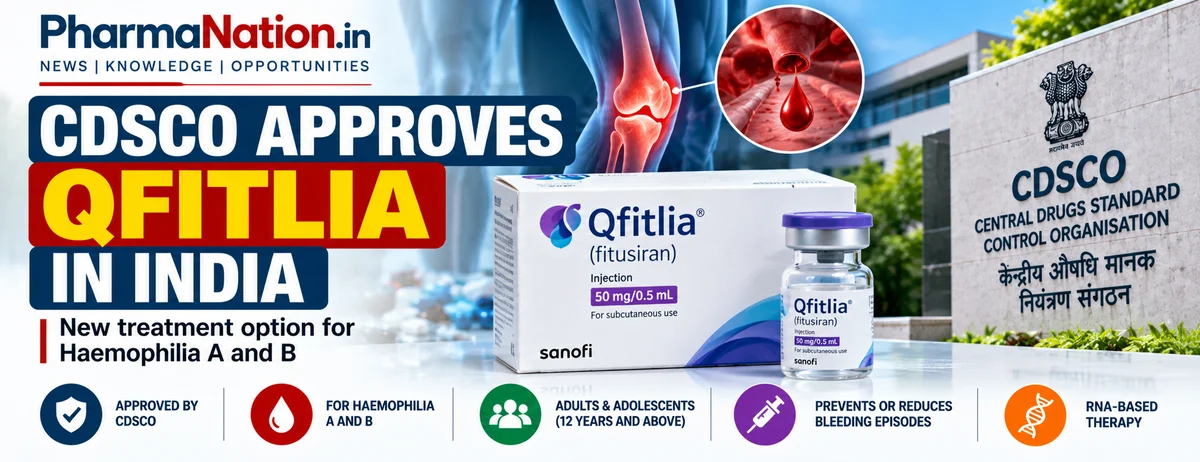
CDSCO Approves Qfitlia in India: New Haemophilia Treatment Explained
CDSCO Flags 330 Drug Samples as Not of Standard Quality in September 2026: What Pharmacists and Patients Should Know



Reader Comments
Comments are reviewed by our desk before they appear. Sign in with your mobile number to join the discussion.