
NPPA Cuts Prices of 543 Cancer Medicine Formulations from November 9
NPPA revises prices for 543 formulations across 137 cancer medicines, with some brand-specific reductions exceeding 90%. Know the new rules and effective date.

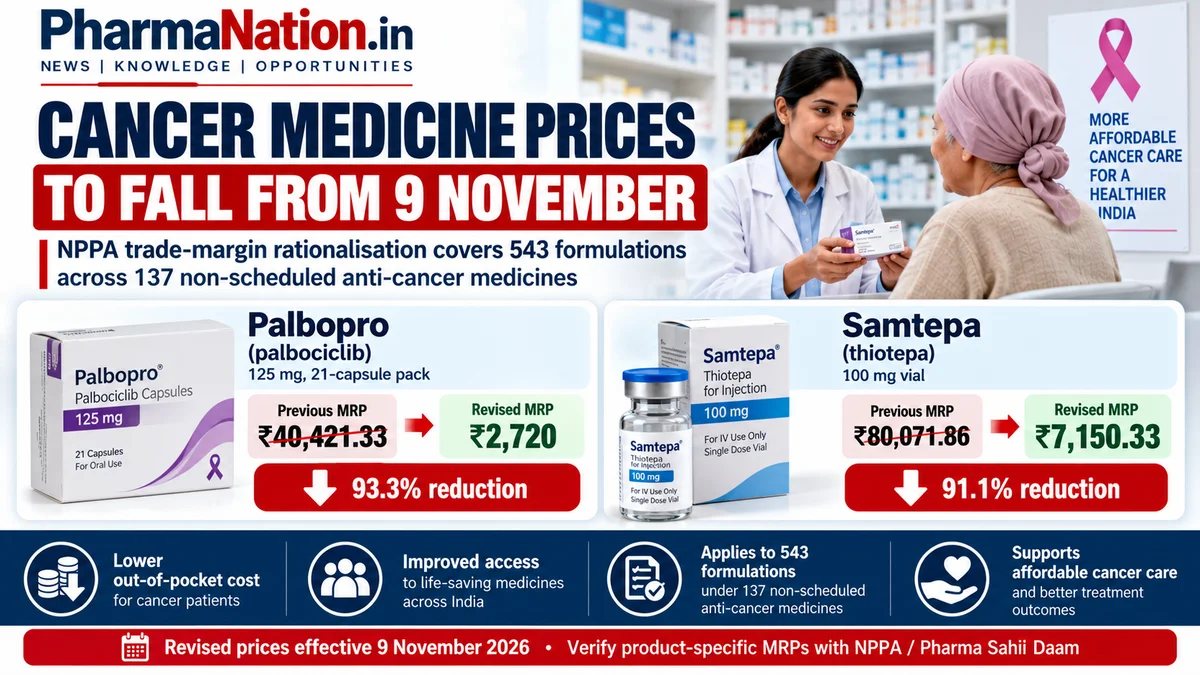
India’s cancer treatment landscape is set for an important pricing change. The National Pharmaceutical Pricing Authority (NPPA) has revised the maximum retail prices (MRPs) of hundreds of anti-cancer medicine formulations under its trade margin rationalisation policy. The new prices are scheduled to take effect on 9 November 2026.
A report published by Mint on 27 October stated that the revised prices cover 543 formulations across 137 non-scheduled anti-cancer medicines, with reductions exceeding 90% for certain brands. The government had announced the underlying policy on 17 October, aiming to make cancer medicines more affordable by limiting trade margins.
1. What has the government announced?
The NPPA, which functions under the Department of Pharmaceuticals in the Ministry of Chemicals and Fertilizers, has introduced trade margin rationalisation for 137 identified non-scheduled anti-cancer medicines.
Under the measure, the trade margin is capped at 30% of the maximum retail price, in accordance with Paragraph 19 of the Drugs (Prices Control) Order, 2013. The government says the measure is intended to reduce excessive margins in the distribution and retail chain while improving access to cancer treatment.
The official announcement identifies medicines used in different cancer treatments, including immunotherapies and other specialised therapies. Examples include pembrolizumab, durvalumab, osimertinib, denosumab, pegfilgrastim and bevacizumab.
The important date for patients and pharmacies is 9 November 2026. Retailers, hospitals and medical institutions must charge the revised prices from that date and display the updated price information.
2. How much will cancer medicine prices fall?
According to Mint’s report of 27 October, the revised MRP of a 21-capsule pack of Palbopro 125 mg, a palbociclib formulation, falls from ₹40,421.33 to ₹2,720. This represents a reported reduction of approximately 93.3%.
The same report stated that a 100 mg vial of Samtepa, a thiotepa injection, falls from ₹80,071.86 to ₹7,150.33—a reduction of ₹72,921.53, or approximately 91.1%. These are specific brand and pack-size examples, not the expected reduction for every formulation.
The government’s initial announcement on 17 October estimated that the policy could reduce MRPs by up to 70%, depending on existing price structures. The subsequently reported brand-specific figures show reductions above 90% in certain cases. Patients should check the exact brand, strength, dosage form and pack size rather than assuming that a headline percentage applies to their prescription.
3. What is trade margin rationalisation?
Trade margin is the amount retained within the supply chain between the price at which a medicine is supplied and its final retail price, subject to the applicable pricing rules.
A medicine may pass through manufacturers, distributors, stockists, pharmacies or hospitals before reaching the patient. Different costs and margins can affect the final amount paid.
Trade margin rationalisation seeks to control excessive margins at relevant stages of this chain. For the medicines covered by the latest NPPA measure, the 30% margin cap is intended to reduce the gap between supply prices and the maximum price charged to patients.
It is important to distinguish this policy from a universal price cap on every medicine in India. The notification covers a specified group of non-scheduled anti-cancer medicines. Other medicines remain subject to their own applicable pricing and regulatory requirements.
4. Why does this matter for cancer patients?
Cancer treatment can involve several expenses, including medicines, diagnostic tests, hospital services, surgery, radiation therapy and follow-up care. For patients requiring expensive targeted therapies, immunotherapies or specialised injections, medicine costs can be a major financial burden.
Lower MRPs on covered formulations may help reduce out-of-pocket spending. They may also improve affordability for patients who need repeated doses or prolonged treatment.
However, the actual benefit depends on the prescribed medicine, its brand, the treatment schedule and whether the patient purchases the covered formulation. Lower medicine prices alone cannot remove all the financial challenges associated with cancer care.
Patients should not change brands, doses or treatment schedules independently because of a price reduction. Any change in the prescribed product should be discussed with the treating oncologist or pharmacist.
5. What should pharmacies, distributors and hospitals do?
• Pharmacies: Update billing systems and price displays before 9 November and ensure that covered products are billed at the applicable revised MRP.
• Distributors and stockists: Communicate updated price information to retailers and verify product-specific details.
• Hospitals: Review procurement, pharmacy billing and website price information for covered medicines.
• Manufacturers and marketing companies: Submit revised prices to NPPA within the required period and publish and circulate updated price lists.
• Patients and caregivers: Check the applicable MRP for the exact formulation and pack size before purchasing.
The government has said that State Drug Controllers will take steps to monitor compliance. Manufacturers are also required to maintain current production and supply levels to help prevent artificial shortages.
6. How can patients verify the revised prices?
Patients should rely on official price information rather than social media posts or general claims about percentage reductions.
The NPPA provides the Pharma Sahi Daam medicine-price checking service, which helps consumers check prices for scheduled and non-scheduled medicines. Visit https://www.nppaindia.nic.in/pharma_sahi_daam.
When checking a medicine, compare the brand name, strength, dosage form and pack size. If the displayed price appears inconsistent with the applicable notified price, patients can seek clarification from the pharmacy or report a suspected pricing violation through the appropriate official channel.
7. What does this mean for the pharmaceutical industry?
The policy reinforces the government's use of pricing regulation to improve access to selected high-cost medicines. It also places greater emphasis on accurate price communication across the supply chain.
For pharmaceutical companies, distributors and hospitals, implementation will require updated systems, coordinated communication and careful stock and billing management.
At the same time, the long-term impact should be assessed through actual patient prices, medicine availability and continuity of treatment. Lower MRPs will deliver meaningful public-health benefits only if patients can obtain the prescribed medicines reliably.
The government has said the list of covered medicines may be updated periodically. Industry stakeholders should therefore monitor official NPPA notifications rather than relying solely on news summaries.
Frequently Asked Questions
1. When do the revised cancer medicine prices become effective?
The revised prices are scheduled to take effect on 9 November 2026.
2. How many medicines are covered?
The measure covers 137 identified non-scheduled anti-cancer medicines, with reported price revisions across 543 formulations.
3. Will every cancer medicine become cheaper by 90%?
No. The reduction varies by brand and formulation. The largest reported reductions apply to specific products and should not be generalised to all cancer medicines.
4. Where can patients check medicine prices?
Patients can use the official NPPA Pharma Sahi Daam service: https://www.nppaindia.nic.in/pharma_sahi_daam.
5. Should patients change their cancer treatment because prices have fallen?
No. Patients should continue following their oncologist’s advice and discuss any proposed change in brand or formulation with their healthcare professional.
Conclusion
The NPPA’s revised prices for 543 formulations across 137 non-scheduled anti-cancer medicines mark an important step in India's effort to improve medicine affordability. Some reported brand-specific reductions exceed 90%, while the overall impact will vary across products.
As the new prices take effect on 9 November 2026, patients, pharmacies and hospitals should verify the applicable MRPs and ensure that billing reflects the official requirements. The real measure of success will be whether lower prices translate into better access to essential cancer medicines without disrupting supply.
Sources and References
1. Department of Pharmaceuticals / PIB — Trade Margin Rationalisation on 137 Anti-Cancer Drugs, 17 October 2026:
https://www.pib.gov.in/PressReleasePage.aspx?PRID=2324743&lang=1®=3
2. Mint — NPPA slashes cancer drug MRPs by up to 93%; Thiotepa cut by ₹72,921, 27 October 2026:
https://www.livemint.com/industry/nppa-slashes-cancer-drug-mrps-by-up-to-93-thiotepa-cut-by-72921-11793117657428.html
3. NPPA — Pharma Sahi Daam medicine price checker:
https://www.nppaindia.nic.in/pharma_sahi_daam
Tags: NPPA, Cancer Medicines, Drug Price Control, Pharmaceutical Industry, India Pharma News, Patient Affordability
Esskay bhayana, being a registered pharmacist & having more than 30+ years of experience, covers news and latest innovations in the pharmaceutical industry.
More from this section
CDSCO Cancels FatX Solution Registration Over Misleading Claims: Key Lessons for India’s Cosmetic Industry

CDSCO Approves Zytorvi for Advanced Oesophageal Cancer in India
CDSCO Approves Qfitlia in India: New Haemophilia Treatment Explained

Reader Comments
Comments are reviewed by our desk before they appear. Sign in with your mobile number to join the discussion.