GST Changes Could Benefit Pharma Inventory Management: What Wholesalers and Retailers Need to Know
India’s GST rationalisation could make pharmaceutical inventory management more efficient, but businesses must update product tax codes, purchase records and pricing systems to avoid costly errors.

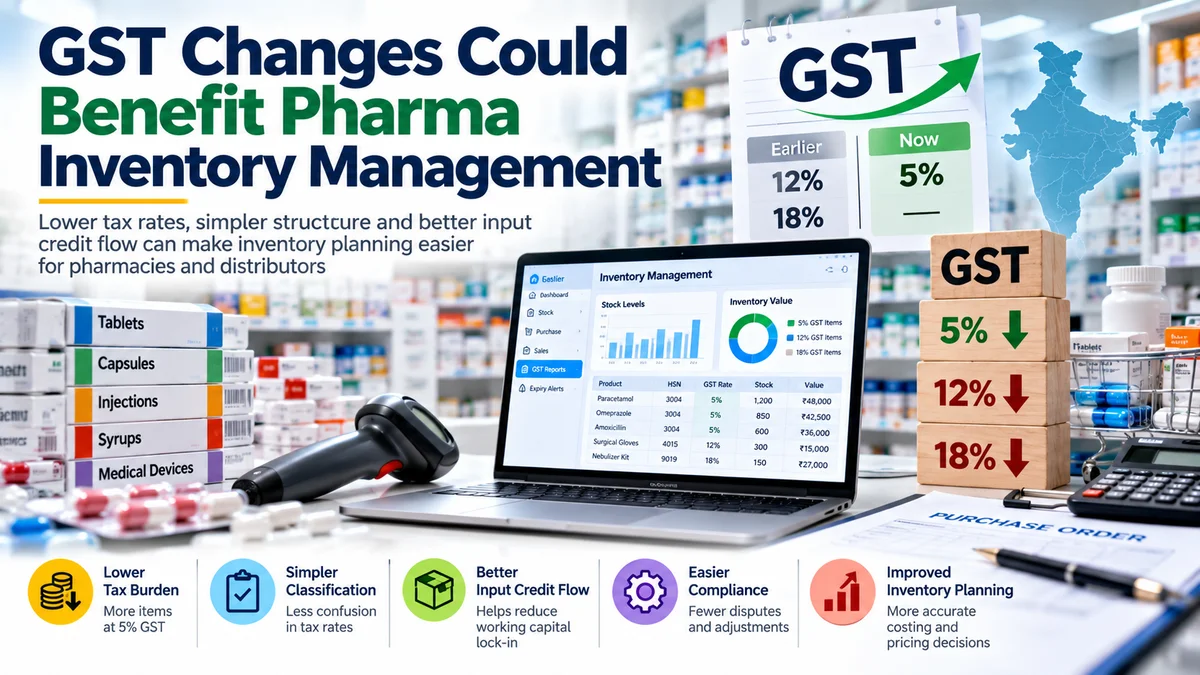
India’s pharmaceutical supply chain operates on tight margins, high stock volumes and strict expiry-date management. Even a small change in taxation can affect thousands of product entries across manufacturers, stockists, distributors, chemists and hospitals.
The GST rate rationalisation that took effect on 22 September 2025 reduced GST on many medicines from 12% to 5%, with specified medicines becoming fully exempt. Several medical devices and healthcare supplies also moved to lower tax rates. However, the applicable rate depends on the product’s classification and the relevant notification. Source: Government of India
For pharmaceutical businesses, the impact goes beyond the tax amount on an invoice. It creates an opportunity to improve inventory accuracy, purchasing decisions and working-capital management.
1. Better inventory valuation and costing
When GST rates change, the tax component of a purchase invoice changes too. Businesses need to distinguish between the product’s basic purchase price, GST, eligible input tax credit (ITC) and the actual inventory cost.
Accurate costing helps wholesalers and retailers answer important questions:
What is the true cost of each product batch?
Has the supplier applied the correct GST rate?
Does the purchase price match the latest price list?
Are margins being calculated correctly after accounting for eligible ITC?
The key: Inventory software should record GST separately from the product’s basic cost instead of treating the invoice total as the product cost in every situation.
2. Simpler stock management—but only with updated product data
A lower GST rate does not automatically simplify every product classification. Pharmaceutical inventories include formulations, medical devices, surgical supplies, supplements and personal-care products, which may fall under different tax classifications.
Distributors should review their product master and ensure that each item has the correct HSN code and GST rate.
A practical product-master checklist:
Product name and manufacturer
Pack size and unit of measurement
HSN code and applicable GST rate
Purchase price and selling price
Batch number and expiry date
Supplier and invoice reference
Correct product-level data reduces the risk of billing errors, mismatched tax reports and inaccurate stock valuation.
3. More informed purchasing and replenishment
Pharma wholesalers frequently purchase the same medicines from regular suppliers, yet invoice prices may vary because of discounts, schemes, revised price lists or other commercial terms.
GST changes add another variable to consider. Comparing invoices without separating the tax component can make a price increase or decrease appear larger—or smaller—than it actually is.
A well-maintained purchase history can help businesses:
Compare the basic purchase price across invoices.
Identify products with frequent price fluctuations.
Detect unusual supplier price changes.
Calculate average purchase cost using a consistent method.
Plan replenishment based on actual demand and available stock.
This is particularly useful for distributors managing thousands of SKUs and placing orders with multiple suppliers every week.
4. Improved cash-flow visibility and ITC reconciliation
Lower GST rates may reduce the tax paid on certain purchases, but they do not guarantee that every pharmaceutical business will see an immediate cash-flow improvement.
Input tax credit depends on the applicable GST rules, the nature of the supply and the business’s eligibility. Where rates on outputs and inputs differ, businesses may also need to review the effect on accumulated credit.
Finance teams should therefore monitor:
GST charged on purchase invoices
Eligible ITC and credit reversals, where applicable
GST collected on sales
Differences between supplier invoices and purchase entries
Tax liabilities and credit balances
Regular reconciliation can prevent avoidable disputes and make working-capital planning more reliable.
5. Handling old stock and revised MRPs
One of the practical challenges following a tax-rate change is managing inventory purchased before the change but sold afterwards.
Government guidance issued in September 2025 clarified that recalling or relabelling older packs was not mandatory in the specified circumstances, provided manufacturers or marketing companies ensured price compliance at the retailer level. Revised price lists and supplementary price lists were also addressed in the guidance. Businesses should consult the applicable NPPA instructions and product-specific requirements rather than assuming all old stock can be handled identically. Source: PIB GST FAQs
For distributors and retailers, the priority is to maintain clear records linking old purchase invoices, revised price lists and the selling price applied to each product.
6. Why pharma businesses need smarter inventory software
Manual accounting and spreadsheets can work for a small product range, but become difficult to manage as the number of suppliers, invoices and stock items grows.
A useful pharma inventory system should offer:
GST-aware billing: Product-level tax rates and HSN codes.
Purchase-price history: Invoice-wise comparisons for the same SKU.
Batch and expiry tracking: Better visibility of near-expiry stock.
Supplier comparison: Purchase-cost analysis across vendors.
Stock alerts: Reorder reminders based on sales and available inventory.
Accounting reconciliation: Clear links between purchases, sales and tax records.
Automation cannot replace correct tax classification or professional accounting advice. It can, however, make errors easier to detect and routine decisions faster.
What should pharma wholesalers and retailers do now?
Businesses can begin with five practical steps:
Update GST rates against the correct product classifications using official notifications.
Review inventory and billing software for outdated tax codes.
Compare recent purchase invoices to identify changes in basic prices separately from GST.
Reconcile eligible ITC and review old-stock pricing documentation.
Generate monthly reports on purchase-cost changes, slow-moving inventory and near-expiry products.
PharmaNation’s perspective
GST rationalisation is not merely a taxation issue for the pharmaceutical trade. It is also a reminder that accurate product data and invoice-level purchase tracking are essential for profitable inventory management.
For wholesalers and retailers working on narrow margins, knowing the exact purchase cost of every medicine can be as important as knowing how much stock is available. Businesses that combine GST-compliant accounting with reliable inventory analytics will be better equipped to control costs, manage suppliers and make purchasing decisions with confidence.
The real advantage will come not from a lower rate alone, but from using accurate financial and inventory data to run a more efficient pharmaceutical supply chain.
Disclaimer
This article is intended for general informational and educational purposes only. GST rates, HSN classifications, input tax credit eligibility and pricing requirements may vary depending on the product, transaction and applicable regulations. Readers should verify the latest notifications and guidance issued by the CBIC, GST authorities and other relevant regulators, and consult a qualified tax professional before making compliance or business decisions. PharmaNation does not guarantee the accuracy or completeness of every interpretation and accepts no liability for decisions taken solely on the basis of this article.
PharmaNation Editorial Note: GST changes are an opportunity for pharma businesses to strengthen cost tracking, improve inventory accuracy and make smarter purchasing decisions. Always verify applicable tax rates and compliance requirements before updating your systems.
Esskay bhayana, being a registered pharmacist & having more than 30+ years of experience, covers news and latest innovations in the pharmaceutical industry.
More from this section
Drug Licence Compliance in India: ONDLS Integration Could Reduce Paperwork for Pharmacies and Wholesalers

Cancer Medicine Prices in India: Will the 30% Trade-Margin Cap Bring Relief to Patients?

India’s Clinical Research Revolution: NIPER Raebareli and AstraZeneca Join Hands to Strengthen 25 Clinical Trial Sites