
CDSCO Permits Phase IV Study of Alzheimer’s Drug Donanemab in India: What Patients Need to Know
Could a new clinical study help doctors better understand an advanced treatment for Alzheimer’s disease in Indian patients?

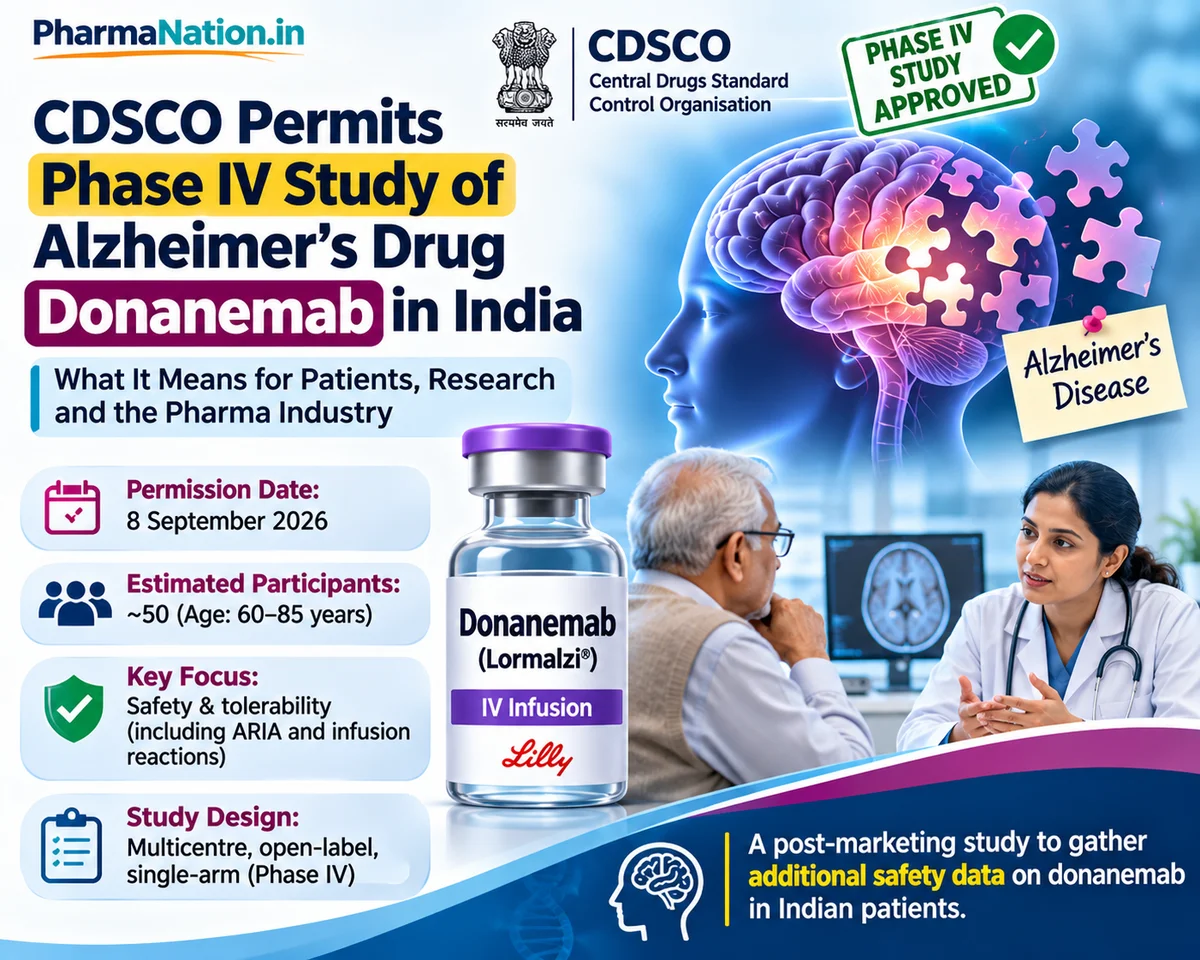
India has taken another step in Alzheimer’s disease research. The Central Drugs Standard Control Organisation (CDSCO) has granted permission to Eli Lilly and Company (India) to conduct a Phase IV clinical study of donanemab in Indian patients with early symptomatic Alzheimer’s disease.
The permission was issued on 8 September 2026. The study will focus on the medicine’s safety and tolerability in Indian participants.
The development is important because donanemab has already received marketing authorisation in India. The new study is intended to generate additional safety information after the medicine's approval.
Let us understand what donanemab is, how it works, what the new study will examine and why this development matters to patients and the pharmaceutical industry.
1. What Has CDSCO Approved?
CDSCO has granted Eli Lilly and Company (India) Pvt. Ltd. permission under Form CT-06 to conduct a Phase IV clinical trial.
According to the official permission letter, the study is titled:
A Phase 4, Multicentre, Open-Label, Single-Arm Study to Evaluate the Safety and Tolerability of Donanemab in Indian Participants with Early Symptomatic Alzheimer’s Disease.
Key details of the study
Company: Eli Lilly and Company (India) Pvt. Ltd.
Medicine: Donanemab
Study phase: Phase IV
Permission date: 8 September 2026
Study design: Multicentre, open-label and single-arm
Main objective: Evaluate safety and tolerability in Indian participants.
An important distinction: Permission to conduct a clinical trial is not the same as approval to market a medicine.
Donanemab had already received CDSCO marketing authorisation on 18 November 2025. Eli Lilly launched the medicine in India under the brand name Lormalzi on 13 May 2026.
2. What Is Donanemab and How Does It Work?
Donanemab is a monoclonal antibody medicine developed for certain patients with early symptomatic Alzheimer’s disease.
Alzheimer’s is a progressive brain disorder that affects memory, thinking, behaviour and the ability to perform everyday activities.
One of the important features associated with the disease is the accumulation of abnormal amyloid-beta protein deposits, known as amyloid plaques, in the brain.
How does donanemab work?
Donanemab targets a form of amyloid protein and helps the body's immune system remove amyloid plaques from the brain.
Its purpose is to slow the decline in cognitive and daily functioning in appropriately selected patients with early symptomatic Alzheimer’s disease.
However, there is something patients and families must understand:
Donanemab is not a cure for Alzheimer’s disease.
It is not intended for everyone who experiences forgetfulness or memory problems. Patients require specialist assessment and confirmation that they meet the approved treatment criteria.
3. What Will the New Phase IV Study Examine?
This is perhaps the most important part of the announcement.
According to the public clinical-trial registry, the study has an estimated enrolment of around 50 participants. The registry snapshot updated on 15 October 2026 listed the study as not yet recruiting, with a planned start in November 2026.
These are planned details, not confirmation that recruitment has started.
The study will pay particular attention to two important safety areas.
A. Amyloid-Related Imaging Abnormalities (ARIA)
ARIA is an important safety concern associated with amyloid-targeting treatments.
It refers to changes that may be detected through brain MRI scans, including:
Swelling or fluid accumulation in the brain.
Small areas of bleeding in the brain.
Some patients may not experience noticeable symptoms, while others may develop headache, confusion, dizziness or other problems.
Regular monitoring and appropriate MRI examinations are important during treatment.
B. Infusion-Related Reactions
Donanemab is administered through an intravenous (IV) infusion.
Some patients may experience reactions during or after the infusion. The study will examine how frequently these reactions occur and how severe they are.
Other assessments
Researchers will also examine:
Changes in the Mini-Mental State Examination (MMSE) score.
Blood levels of phosphorylated tau 217 (P-tau217), a biomarker associated with Alzheimer's disease.
The public registry describes follow-up of up to approximately 84 weeks per participant, with study visits scheduled every four weeks.
4. Why Is a Phase IV Clinical Trial Important?
Clinical trials are conducted in different phases during the development of a medicine.
Early studies generally focus on safety and dosing. Later studies examine effectiveness and safety in larger groups of patients.
Phase IV studies take place after a medicine receives marketing authorisation.
Their purpose is to collect additional information about the medicine's safety and use after approval.
For donanemab, the Indian study may help doctors and researchers understand how the treatment is tolerated by Indian patients.
However, the study has an open-label, single-arm design. This means there is no separate control group for comparison.
Therefore, it should primarily be understood as a post-marketing safety and tolerability study, rather than a new comparative trial designed to prove that the medicine is more effective than other treatments.
5. What Safety Conditions Has CDSCO Imposed?
CDSCO has included several conditions in its permission letter to ensure that the study is conducted responsibly.
These include:
Approval from the relevant Ethics Committee.
Registration with the Clinical Trials Registry of India (CTRI) before enrolling the first participant.
Compliance with Good Clinical Practice (GCP).
Proper monitoring of patient safety and research data.
Submission of periodic progress and safety reports.
Reporting of serious adverse events within the prescribed timelines.
The permission letter specifies that, following the required analysis, serious adverse event reports must be submitted to the Central Licensing Authority, the Ethics Committee chairperson and the relevant institute within 14 days.
The letter also sets out requirements concerning medical management and compensation in cases of trial-related injury.
Clinical trial safety does not end with regulatory permission. It requires continuous monitoring throughout the study.
6. What Does This Mean for Indian Patients?
The new study may provide additional information about the safety and tolerability of donanemab in Indian participants.
For patients and their families, however, it is important to understand the limitations.
Donanemab is not suitable for every person with memory problems.
Treatment requires specialist assessment and appropriate diagnostic confirmation.
Potential risks, including ARIA, must be discussed with the treating doctor.
MRI monitoring and medical supervision are important.
The new study does not announce a reduction in medicine prices or a government supply programme.
A new clinical study does not mean that every patient should start the medicine. Treatment decisions must be made by qualified specialists after evaluating the individual patient.
7. What Does This Development Mean for the Pharmaceutical Industry?
The study highlights the growing importance of biologics, advanced therapies and post-marketing clinical research in India.
Medicines such as donanemab require specialised research, careful safety monitoring and advanced clinical infrastructure.
This development may also create opportunities for:
Clinical Research Organisations (CROs).
Hospitals and specialised neurology centres.
Clinical research professionals.
Pharmacovigilance teams.
Regulatory affairs specialists.
Diagnostic and imaging facilities.
For pharmacy and life-science students, it is another indication that areas such as clinical research, biologics, pharmacovigilance and regulatory affairs are becoming increasingly important career fields.
Conclusion: An Important Step for Alzheimer’s Research in India
CDSCO’s permission for a Phase IV donanemab study is an important development in India's Alzheimer’s research landscape.
Since the medicine has already received marketing authorisation and has been launched in India, the new study will focus on gathering additional information about its safety and tolerability in Indian patients.
The study's recruitment, progress and eventual findings will be important to watch.
For patients, accurate diagnosis, specialist guidance and safety monitoring remain essential. For the pharmaceutical industry, this development reinforces an important message: regulatory approval is only one milestone; continued research and patient safety must remain priorities.
Frequently Asked Questions (FAQs)
1. Has donanemab been approved in India?
Yes. CDSCO granted marketing authorisation in November 2025. Eli Lilly subsequently launched it in India under the brand name Lormalzi in May 2026.
2. What is donanemab used for?
It is a monoclonal antibody medicine intended for certain patients with early symptomatic Alzheimer’s disease.
3. Does donanemab cure Alzheimer’s disease?
No. It is designed to slow cognitive and functional decline in eligible patients. It is not a cure.
4. What is a Phase IV clinical trial?
A Phase IV study is conducted after a medicine receives marketing authorisation. It collects additional information about the medicine's safety and use.
5. What are the major safety concerns with donanemab?
Important concerns include amyloid-related imaging abnormalities (ARIA) and infusion-related reactions. Medical supervision and appropriate monitoring are essential.
Donanemab India, Lormalzi, Alzheimer’s disease treatment, CDSCO clinical trial approval, Phase IV clinical trial, Eli Lilly India, Alzheimer’s research India.
Sources and Further Reading
CDSCO – Official Donanemab Phase IV Clinical Trial Permission Letter (8 September 2026):
https://cdsco.gov.in/opencms/resources/UploadCDSCOWeb/2018/UploadCTApprovals/16_Donanemab_Eli%20Lilly%20And%20Company%20(India)%20Pvt%20Ltd.pdfCDSCO – Clinical Trial Approvals:
https://cdsco.gov.in/opencms/opencms/en/Approval_new/CT-ApprovalsClinicalTrials.gov – Donanemab Indian Phase IV Study (NCT07838155):
https://clinicaltrials.gov/study/NCT07838155Eli Lilly – Donanemab Receives CDSCO Marketing Authorisation:
https://www.lilly.com/in/news/press-releases/lilly-s-donanemab-receives-cdsco-approval-for-the-treatment-of-early-symptomatic-alzheimer-s-diseaseEli Lilly – Lormalzi Launch in India:
https://www.lilly.com/in/news/press-releases/lilly-launches-lormalzi-donanemab-first-and-only-once-monthly-amyloid-plaque-targeting-therapy-for-the-treatment-of-early-symptomatic-alzheimer-s-disease-in-india
Disclaimer: This article is intended for educational and informational purposes only. It is not a substitute for medical advice. Patients should consult qualified healthcare professionals before making any treatment decisions.
Editorial note: Trial enrolment and planned dates are based on the public registry snapshot updated on 15 October 2026. These details may change as the study progresses.
Esskay bhayana, being a registered pharmacist & having more than 30+ years of experience, covers news and latest innovations in the pharmaceutical industry.
More from this section
भारत में अल्जाइमर के इलाज पर नई रिसर्च: CDSCO ने Donanemab की Phase IV स्टडी को दी मंजूरी
भारत में BPaL टीबी उपचार का पेटेंट आवेदन खारिज, मरीजों को क्या होगा फायदा?
India Rejects BPaL TB Drug Patent Application: Impact on Generic Medicines



Reader Comments
Comments are reviewed by our desk before they appear. Sign in with your mobile number to join the discussion.