Drug Licence Compliance in India: ONDLS Integration Could Reduce Paperwork for Pharmacies and Wholesalers
A new recommendation could simplify drug-licence retention, reduce repetitive documentation and make regulatory compliance easier for India's pharmaceutical trade.

By PharmaNation Editorial Desk | 15 October 2026
For a pharmaceutical wholesaler or retail chemist, running a business involves much more than purchasing medicines and supplying customers. Drug licences, retention fees, documentation, inspections and regulatory compliance are ongoing responsibilities that demand time and attention.
Now, a recommendation from India's Drugs Consultative Committee (DCC) could make one part of this process simpler.
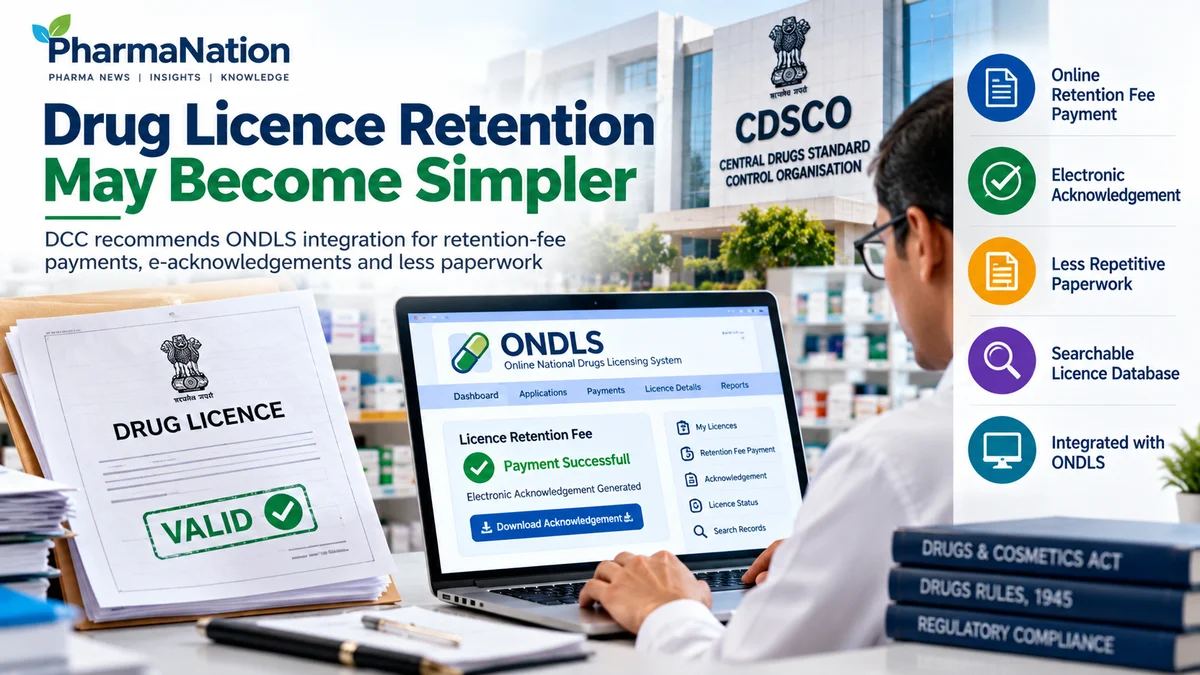
At its 70th meeting on 18 September 2026, the DCC recommended integrating drug-licence retention-fee payments with the Online National Drugs Licensing System (ONDLS). It also recommended electronic acknowledgements, a searchable database of retained licences and reduced repetition of documents already submitted during the original licensing process.
For PharmaNation, this is a practical regulatory development worth watching—particularly for pharmacies, medicine wholesalers and other businesses operating under drug-sale licences.
1. What has the DCC recommended?
The DCC examined the existing process for retaining drug licences under Rule 63 of the Drugs Rules, 1945.
The committee noted that some licensing processes require businesses to obtain a separate retention certificate and submit documentation resembling a fresh licence application, even though the rules provide for retention through payment of the prescribed fee.
Its recommendations include:
Integrating retention-fee payments with ONDLS.
Automatically generating electronic acknowledgements after payment.
Maintaining a searchable database of retained licences.
Ordinarily avoiding separate retention certificates and repeated submission of original-grant documents unless specifically required under the rules.
Encouraging states that have not integrated these processes with ONDLS to align their systems accordingly.
Important: These are DCC recommendations. Businesses should not assume that every state has implemented the proposed process or that existing compliance requirements can be ignored.
2. What is ONDLS, and why does it matter?
The Online National Drugs Licensing System is a digital platform developed by the Centre for Development of Advanced Computing (C-DAC), in collaboration with the Central Drugs Standard Control Organisation (CDSCO) and state drug regulatory authorities.
It supports online processing of various pharmaceutical licensing applications, including manufacturing and sale licences.
The broader objective is to improve transparency, consistency and efficiency in drug regulation.
Integrating licence-retention payments into the system could make it easier for businesses and regulators to verify whether the required fee has been paid and maintain accurate licence records.
For businesses managing multiple licences, a reliable digital record could also simplify internal compliance tracking.
3. How could this benefit pharmacies and wholesalers?
The potential benefits are practical rather than dramatic.
Less repetitive paperwork: Businesses may avoid resubmitting documents already available to the licensing authority, wherever the revised process permits.
Better payment records: Electronic acknowledgements can help establish a clear record of retention-fee payments.
Easier verification: A searchable database could make licence-status checks more convenient for businesses and regulators.
Improved compliance management: A more streamlined digital process could reduce administrative effort and help businesses maintain organised records.
For smaller pharmacies and wholesale distributors, even modest reductions in repetitive compliance work can free up time for inventory management, supplier coordination and customer service.
However, these benefits will depend on how the recommendations are implemented by individual state licensing authorities.
4. Does your drug licence need renewal every five years?
This is an important distinction for pharmaceutical businesses.
Under Rule 63, licences covered by the relevant provisions remain valid subject to payment of the prescribed retention fee before the expiry of each succeeding five-year period, unless suspended or cancelled by the licensing authority.
Failure to pay by the due date can attract the applicable late fee.
Therefore, businesses should distinguish between the retention of an existing licence and obtaining a new licence or making a fresh application for a change that requires regulatory approval.
The DCC's recommendation does not remove the obligation to pay the prescribed fee or maintain compliance with the Drugs Rules.
If your licence is approaching its retention-fee due date, check the applicable state process rather than waiting for the proposed system changes.
5. What should pharma businesses do now?
Until the relevant state authority confirms implementation, a cautious approach is advisable.
Check the licence details and retention-fee due dates for each licensed premises.
Maintain copies of existing licences, payment receipts and regulatory correspondence.
Verify your licence status through the official ONDLS portal.
Follow instructions issued by your state drug licensing authority.
Do not assume that a separate certificate, application or document is unnecessary until the applicable process confirms it.
These steps can help prevent avoidable compliance problems while the digital process evolves.
PharmaNation's perspective: Better regulation should mean less paperwork, not weaker compliance
At PharmaNation, we believe that digitalisation can make a meaningful difference to India's pharmaceutical trade when it addresses real operational problems.
A pharmacy owner or wholesaler should be able to fulfil regulatory obligations through a clear, predictable and transparent process. Repeated paperwork that adds little value can consume time without necessarily improving medicine safety.
At the same time, drug licensing is fundamental to public health. Simplification must not compromise verification, accountability or compliance.
The DCC's recommendation points towards a sensible balance: preserve regulatory oversight while making licence-retention procedures more efficient.
The next step is implementation. Businesses should watch for official state-level instructions and continue following existing requirements until changes are formally adopted.
Our view: India's pharmaceutical regulatory system should aim to make compliance easier to complete and easier to verify. If ONDLS integration delivers that outcome, it could be a welcome improvement for pharmacies and wholesalers across the country.
Sources
CDSCO — Minutes of the 70th Drugs Consultative Committee meeting, 18 September 2026
PharmaBiz — DCC recommends integration of retention-fee payment with ONDLS
Disclaimer: This article is for pharmaceutical industry news and educational purposes. Refer to the applicable rules and state drug licensing authority for requirements affecting your licence.
Esskay bhayana, being a registered pharmacist & having more than 30+ years of experience, covers news and latest innovations in the pharmaceutical industry.
More from this section
Drug Recall in India: What Happens When a Medicine Fails a Quality Test?

Drug Regulations in India: Rules, CDSCO, Schedules & Pharmacy Compliance
GST Changes Could Benefit Pharma Inventory Management: What Wholesalers and Retailers Need to Know